
Tree Trimming in Bryan, College Station & the Brazos Valley
Tree trimming cuts back branches that are dead, damaged, or growing somewhere they should not. We trim trees across Bryan, College Station, Franklin, and Navasota.
That covers limbs over a roof, branches near power lines, and dead wood that will come down on its own eventually. Where the tree is an oak, timing matters as much as technique.
What Tree Trimming Actually Involves
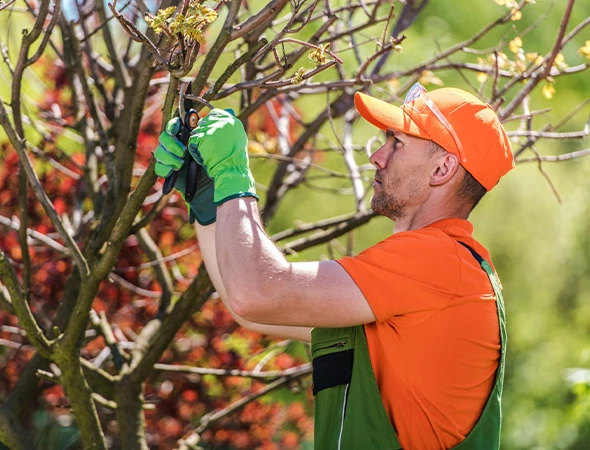
Tree trimming is the routine work of cutting back branches to keep a tree’s shape neat and safe, without going into deeper structural pruning. Our crew removes limbs that hang over rooflines, block driveways, or grow too close to power lines, along with dead or weak branches that could break off in wind or storms.
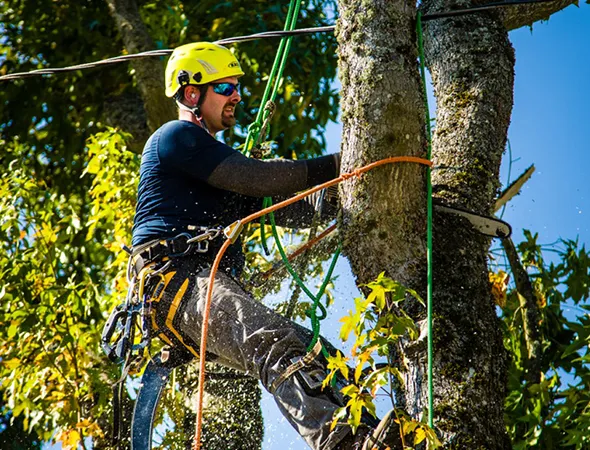
Trimming also improves how sunlight and air move through the tree’s canopy, which helps it stay healthy over time. We use hand tools and pole saws for smaller branches, and climbing gear or bucket trucks for taller trees that need work higher up.
Where the cut lands decides whether the tree seals it. Every branch has a collar at its base, a slight swelling where it meets the trunk, and that collar contains the tissue the tree uses to close a wound. Cut outside the collar and the tree seals over within a season or two. Cut flush to the trunk and you have removed the collar along with the branch, which leaves a wound the tree cannot close.
That is why a flush cut looks tidier and is worse. Leaving a long stub is the opposite mistake, because the stub dies back and decay works down it into the trunk.
Time for a Trim? Watch for These Signs
Branches Touching the Roof
A branch resting on shingles wears them every time the wind moves. It also gives squirrels and roof rats a bridge, and drops leaf litter straight into your gutters.
Limbs Over the Driveway
Low limbs over a driveway or walkway are a clearance problem that gets worse each season. Around eight feet over a walkway and fourteen over a driveway is the usual working standard.
Branches Near Power Lines
Branches near a service line are a safety issue and often the property owner's responsibility. Anything actually touching a line is the utility's job, not ours, and we will tell you which one you have.
Dead Wood in the Canopy
Dead branches will fall on their own schedule rather than yours. Dead wood is also the easiest thing to remove safely, because nothing living is being cut.
It Has Been a Year or More
A canopy you can no longer see through has thickened enough to hold wind rather than let it pass. That is what turns a gust into a broken limb.
What Happens During a Trimming Visit
Assessment
We walk the tree and agree what comes off and why, before anything is cut. On an oak we also check the calendar, because that decides whether the job happens now or waits.
Upfront Pricing
You get a fixed price based on the tree’s size, how much is coming off, and access. It does not change once the crew arrives.
Setup
Ladders, pole saws, climbing gear, or a bucket truck depending on height and reach. Anything underneath that can be moved gets moved.
Trimming
Cuts are placed outside the branch collar so the tree can seal them. We take no more than about a quarter of the live canopy in one visit, and less on a tree already under stress.
Cleanup
Brush goes through the chipper and the ground gets raked. Then a walk round with you before the crew leaves.
When Not To Trim An Oak
Do not prune oaks between February and June. Oak wilt spreads in that window, and a fresh cut is the way it gets in.
The mechanism is specific. Red oaks are the only oaks that grow fungal mats, sap-feeding beetles carry spores from those mats, and the beetles are drawn to fresh wounds. A cut made in February gets found. The same cut made in November does not.
July through January is the safe stretch, and mid-winter is best. That is also when the tree is dormant, so it is the right time on both counts.
If an oak has to be cut in the risky window, the wound gets painted immediately. Storm damage does not wait for the calendar. This is the part that surprises people, because the standard advice everywhere else is to leave pruning cuts unpainted and let them seal naturally. In oak wilt country that advice is reversed, and the paint goes on within minutes rather than at the end of the day.
The same applies to any accidental wound on an oak — a mower strike, a limb torn off in wind, damage from construction equipment.
Non-oaks are not affected by this, and most of what we trim can be done any time of year.
Why Brazos Valley Trees Need Regular Trimming
Tree age decides how often a tree needs attention, and the Brazos Valley has trees at every stage.
Bryan’s established neighborhoods hold the oldest trees in the region. Post oaks and pecans across the Post Oak Savannah develop wide canopies and heavy horizontal limbs over decades, and an old limb sheds in high wind whether the tree is healthy or not. These are the trees where regular attention pays for itself.
College Station’s newer subdivisions have the opposite problem. Trees there are often young enough that what they need is formative work — setting branch structure while the branches are still small enough to remove cheaply. A cut that takes thirty seconds at year four takes a bucket truck at year twenty.
Franklin and Navasota have large bottomland trees near the rivers, growing fast in deep moist soil and putting on weight faster than upland trees do.
Storm season applies to all three. Weak, dead, and overextended branches are the ones that come down in high wind, and they are also the ones a trim would have taken off.
If a tree is too far gone to save through trimming, hazardous tree removal is the honest answer, and we will say so rather than sell you a trim that will not fix it. That normally means stump grinding once the tree is gone as the second half of the same job.
Tree Trimming vs. Tree Pruning
Trimming manages a tree’s shape and clearance. Pruning manages a tree’s health and structure.
Trimming is routine maintenance — keeping a canopy off a roof, clearing a driveway, taking out growth that has got away from you. It is about where the branches are.
Pruning goes after the tree’s condition. Weak branch unions that will split, crossing limbs rubbing each other’s bark open, diseased wood, and structural problems that will shorten the tree’s life if left. It is about which branches should exist at all.
A tree that just needs its shape kept usually wants trimming once or twice a year. A tree showing dieback, thinning, or storm damage needs the second kind of look, and that starts with a tree health check rather than with a saw.
FAQs
Once or twice a year suits most trees, depending on species and growth rate. Fast growers near a roof or a power line need it more often. Established slow growers can go two or three years. On oaks the schedule has to work around the February to June window regardless of what the tree wants.
Yes, with the important exception. Branches near a service line we can work on. Branches actually touching a line, or on the line running from the pole to the transformer, are the utility company's responsibility and theirs to clear first. We will tell you which situation you have rather than working near something we should not.
Yes, and it is the most common way a tree gets damaged by good intentions. Taking too much live canopy at once removes the leaves the tree feeds itself with, and it responds by throwing up weak, fast water sprouts. We keep to roughly a quarter of the live canopy in a single visit, and less on a stressed tree, which sometimes means spacing a big reduction across two visits.
Late winter is best for most trees, while they are dormant and before spring growth starts. Dead and hazardous branches come off whenever they are spotted, because waiting on those increases the risk of them dropping. Oaks are the exception to the general rule, and February to June is off limits for them.
Yes, across Bryan, College Station, Franklin, and Navasota. Commercial work often needs scheduling around business hours or foot traffic, which gets arranged at the estimate.
Contact Us
Ready to get your trees trimmed? Call (979) 774-4800 or email brazosvalleystumpandtree@gmail.com for a free estimate.
Serving Bryan, College Station, Franklin, and Navasota.


