Emergency Tree Removal in Bryan, College Station & the Brazos Valley
Tree removal takes down a tree that is dead, dying, or unsafe where it stands. We remove trees across Bryan, College Station, Franklin, and Navasota.
A tree close to a house, fence, or power line comes down in roped sections rather than one piece. Every job ends with the wood, branches, and sawdust hauled away. We answer storm calls.
What Tree Removal Actually Involves
A removal starts with three decisions made before any saw runs. Which way the tree wants to fall. What sits underneath it. And whether it can come down in one piece or has to be taken apart from the top.
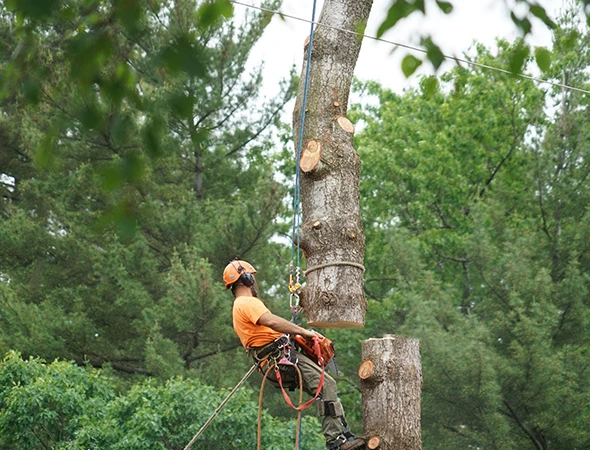
A tree with open space around it can be felled whole. That is the fastest and cheapest way, and it is the right call on maybe a third of the jobs we do. Everything else comes down in sections, with each limb and trunk piece roped and lowered instead of dropped. Larger trees may need a bucket truck to reach the upper canopy safely.
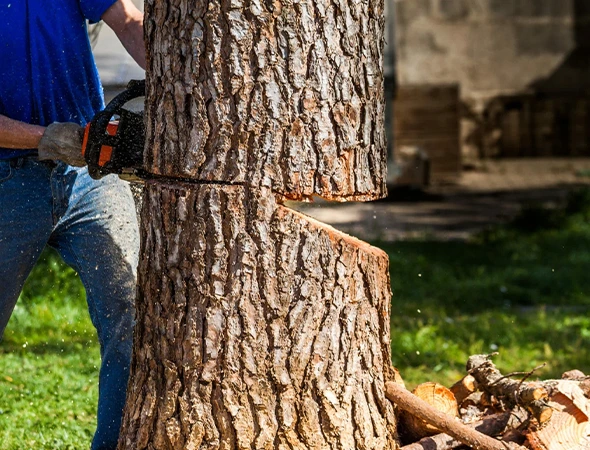
Once the tree is down we cut it into manageable lengths, load it out, and handle stump grinding after removal if that is part of the job. The site gets cleared of branches, chips, and sawdust before we call it finished.
Warning Signs a Tree Needs to Come Down
A Lean That Has Changed
A tree leaning more than it used to is a root problem, not a shape problem. Look for cracked or heaving soil on the side opposite the lean, which means the root plate is lifting.
Large Dead Sections
Bare limbs during the growing season mean those limbs are dead. A tree that is more than a quarter dead is usually past saving, and dead wood falls without warning.
Fungus at the Base
Mushrooms at the base of a trunk signal root or butt decay. The tree can look full and healthy above while the wood holding it up is already failing.
Existing Storm Damage
A split trunk or a broken major limb is structural damage. Trimming tidies the wound but does not restore the strength that was lost.
Too Close for Comfort
Some trees are removed for position rather than health. A large healthy tree directly over a roof is a risk that trimming cannot solve.
From Call to Cleanup
Assessment
We look at the tree in person. Species, condition, lean, dead wood, and what sits under it. Access matters as much as size, because a tree a truck can reach costs less to remove than the same tree behind a locked gate.
Upfront Pricing
You get a fixed price before anything starts. It is based on size, position, and difficulty of access, and it does not change once the crew arrives.
Setup
We clear and protect the drop zone before a saw runs. Vehicles get moved, furniture and pots get shifted, and anything that cannot move gets covered. Most property damage in this trade happens because nobody planned this step.
Removal
The tree comes down in the method agreed at the quote. Sections get roped and lowered near structures and power lines, or felled whole where there is room.
Cleanup
Brush goes through the chipper, logs get cut and loaded, and the ground gets raked. Then one of us walks the site with you before the crew leaves.
WHY SOME BRAZOS VALLEY TREES FAIL SOONER THAN OTHERS
Soil decides how well a large tree stays anchored. The Brazos Valley has two very different kinds of it, sometimes on the same street.
River-bottom ground. Navasota sits on a bend of the Navasota River, close to where it meets the Brazos, and parts of Bryan and Franklin sit on similar floodplain soil. Big trees grow fast in that deep, moist ground. They also lean and uproot more readily after heavy rain, because soft soil gives up its grip before the trunk gives up. Most of our emergency calls come from ground like this.
Post Oak Savannah upland. Away from the rivers, the soil is tighter and sandier. Post oak and pecan hold better here, but they grow wide, heavy canopies over decades, and old limbs shed in high wind whether the roots are sound or not.
Bryan’s established neighborhoods have the oldest trees in the region, and College Station’s newer subdivisions often have trees left standing through construction, with roots cut or compacted by machinery years before the tree shows it.
If a storm has taken one tree, the ones around it took the same wind. An arborist assessment on the neighbors is worth more the week after a storm than six months later.
DO YOU NEED A PERMIT TO REMOVE A TREE?
Permit rules depend on your city, and they differ between towns only a few miles apart.
Under Texas state law, most municipalities cannot charge a mitigation fee for removing a tree under 10 inches in diameter on residential property. Larger trees, and trees the city has listed as protected, can need approval first in places with a formal tree ordinance.
Bryan, College Station, Franklin, and Navasota each handle this differently, so the safest move is one call to your city before a large or old tree comes down. Dead and storm-damaged trees are usually treated separately from healthy ones being removed for convenience, and they normally move faster.
We will tell you at the quote if we think your tree falls into a category worth checking. If you are removing a tree you still want shade from, planting a replacement tree is easiest to plan while the crew is already booked.
FAQs
Cost depends on the tree's size, how close it is to a structure, and whether it is already down. A tree lying in an open yard is often cheaper to clear than one still standing over a roof, because the second needs rigging and the first mostly needs cutting and loading. Access changes the price as much as size does.
Texas homeowners policies often cover removal when a storm brought the tree down onto a covered structure. They usually do not cover taking down a healthy tree you simply want gone, or a tree that was already dead and left standing. Photograph the damage before anything is moved, because that is what the adjuster will ask for.
We prioritize trees that are blocking a driveway, resting on a structure, or holding a broken limb overhead. Response times stretch during widespread storms, when several properties in the area need help at once. If a power line is involved, the utility company has to clear it before anyone cuts.
Yes. The wood is hauled away by default, but tell us beforehand and we will cut the trunk into lengths you can split and leave it stacked. It costs nothing and saves us a load.
Emergency removal deals with a tree that has already fallen or is about to. Scheduled removal is planned in advance for a tree that is declining but not yet dangerous. We do both, and emergencies get moved ahead of scheduled work when safety is involved. A declining tree removed on a schedule almost always costs less than the same tree removed at night in the rain.
Contact Us
Dealing with a fallen or hazardous tree right now? Call (979) 774-4800 or email brazosvalleystumpandtree@gmail.com.
Serving Bryan, College Station, Franklin, and Navasota.


