Tree Planting Services in Franklin, TX
Tree planting starts with matching a species to the site, not with digging a hole. We plant trees across Bryan, College Station, Franklin, and Navasota.
The two things that decide whether a new tree lives are the species and the planting depth. Both get decided before the shovel comes out.
What Tree Planting Service Actually Involves
Most trees that die in their first two years were killed at planting, not by weather. Two mistakes account for the majority of it.
Planting too deep is the first. Every tree has a root flare, the point where the trunk widens out before it becomes roots. That flare belongs at or slightly above ground level. Bury it and the bark stays permanently wet, which kills the tissue that moves water up the tree. The tree can take three or four years to die from it, long enough that nobody connects the two.
Nursery stock makes this easy to get wrong, because containers and root balls are often filled higher than the actual flare. We find the flare first and set the depth from that, not from the top of the pot.
Mulch piled against the trunk is the second. A mound of mulch banked up the bark does the same thing as planting too deep. Mulch goes down two to four inches deep, spread wide, and pulled back clear of the trunk.
The rest of it:
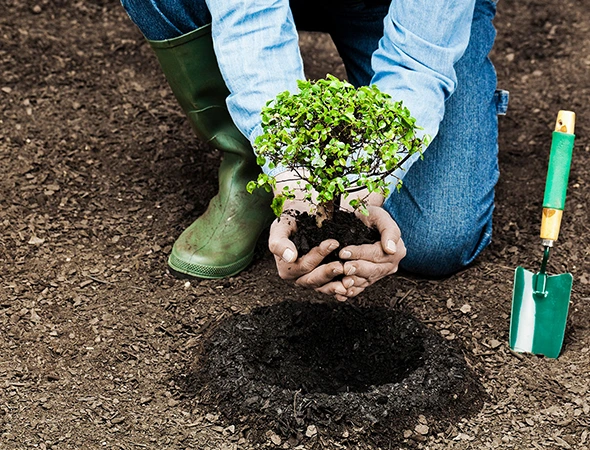
- The hole gets dug two to three times as wide as the root ball, and no deeper than the root ball is tall.
- Containers, burlap, and wire baskets come off completely. Roots circling the inside of a pot get teased out or scored, because a circling root keeps circling and eventually strangles the trunk.
- Backfill goes in as the native soil that came out. Rich imported soil in a clay hole makes a bathtub the roots will not leave.
- The tree gets watered in as we backfill, to settle the soil and clear air pockets.
- Staking only happens if the tree will not stand on its own, and the stakes come off after the first year. A staked tree left staked never develops trunk strength.
- No fertilizer at planting. A new tree needs roots, not top growth.
Reasons Home Owners Plant A Tree
Replacing a Tree That Came Down
A removal leaves a gap that shows most in summer. Replacing it in the same season means the new tree is already established by the time you miss the shade.
Shade Where the House Needs It
A tree on the west side of a house cuts afternoon heat load more than one anywhere else. Afternoon sun is what drives cooling bills in this part of Texas.
A Bare Lot After Construction
New construction lots are usually cleared flat. Planting early matters, because the first years of growth are the ones you cannot buy back later.
Screening a View
A row of the right species screens a neighboring property or road within a few years. The wrong species screens nothing for a decade or outgrows the space entirely.
Not Knowing What Will Grow
Species choice is the decision that most affects whether a tree thrives. Guessing at a nursery is how people spend money twice.
How We Plant A Tree
Site Evaluation
We look at soil type, drainage, sun, mature space available, and what is overhead and underground. Overhead lines and foundation distance rule out more species than soil does.
Species Recommendation & Pricing
We recommend species suited to the site and give you a fixed price. Where a tree came out because of disease, that changes what should go back in.
Digging the Hole
The hole goes two to three times the width of the root ball and no deeper than the ball is tall. We locate the root flare before setting the depth.
Planting
Container or wrapping comes off, circling roots get scored, and the tree goes in with the flare at or just above grade. Native soil goes back, watered in as we fill.
Mulch and Aftercare
Two to four inches of mulch, spread wide and kept clear of the trunk. Then a watering schedule for the first two years, which is the part that decides whether all of the above worked.
When To Plant A Tree In The Brazos Valley
October through February is the best planting window here. Cool weather lets roots establish while the tree is not also trying to support leaves in Texas heat.
A tree planted in fall has months of mild weather to grow roots before the following summer arrives, which is a real head start. Spring planting works as long as watering stays consistent through the first hot stretch. Summer planting is possible but it asks a lot of both the tree and whoever is watering it, because the tree is establishing roots and fighting heat stress at the same time.
Soil Decides Species Across The Brazos Valley
Soil type decides which species will thrive, and the Brazos Valley has two very different kinds of it.
River-bottom and creek soil. Franklin sits in Robertson County where the land splits between rich bottomland near the Brazos and drier upland prairie farther out. Parts of Bryan and Navasota sit on similar floodplain ground. Deep, moisture-holding soil suits pecan, cottonwood, bur oak, and sycamore, all of which will outgrow what the same species manage on dry ground.
Post Oak Savannah upland. Away from the water the soil is tighter and sandier and it dries hard. Post oak, blackjack oak, live oak, and mesquite handle it. Cedar elm handles either, which is part of why it is so common across the region.
Picking a species that matches your soil, rather than whatever looked good at the nursery, is the difference between a tree that thrives and a tree that struggles for a decade. If you are not sure which type your property has, a certified arborist can tell you from the soil and what is already growing nearby.
One thing worth knowing about oaks. If a tree came out because of oak wilt, do not put another oak back in the same spot. The fungus persists in the root system left behind, and a new oak planted into it is a wasted tree. Something outside the oak family is the better choice there.
FAQs
A new tree needs deep watering once or twice a week for the first two years. Roughly five gallons per inch of trunk diameter per watering is a workable guide, so a two-inch tree wants about ten gallons. Slow and deep beats frequent and shallow, because shallow watering trains roots to stay at the surface where they dry out fastest. After two years most well-matched species need very little help.
Yes, but shift it a few feet rather than planting directly on the old root plate. Decomposing roots leave loose pockets and tie up nitrogen as they break down. Where the old stump is still in the ground, grinding out the old stump first gives the new tree room to work with.
Bottomland ground suits pecan, cottonwood, bur oak, and sycamore. Drier upland prairie suits post oak, blackjack oak, live oak, and mesquite. Cedar elm does well in both, which makes it a safe default when the soil is mixed. We recommend from the specific site rather than a list.
A shade tree takes 10 to 20 years to reach full size, though you will see meaningful growth in the first season if it establishes well. Cedar elm and pecan get to usable size faster than oak does. If you want shade sooner, the honest answer is to plant a larger tree, accept a slower establishment period, and water it more.
Yes. Commercial planting covers new construction landscaping, replacing trees lost to storms, and adding shade or screening to an existing business property. Multiple trees on one site are quoted together.
Contact Us
Thinking about adding a tree? Call (979) 774-4800 or email brazosvalleystumpandtree@gmail.com for a free consultation.
Serving Bryan, College Station, Franklin, and Navasota.


