
Stump Grinding in Bryan, College Station & the Brazos Valley
Stump grinding removes a stump below ground level using a machine with a rotating cutting wheel. We grind stumps across Bryan, College Station, Franklin, and Navasota.
How deep we go depends on what you want to do with the spot afterward. Mowing needs less depth than replanting. Tell us which, and the price and the job both follow from that.
What Tree Stump Grinding Actually Involves
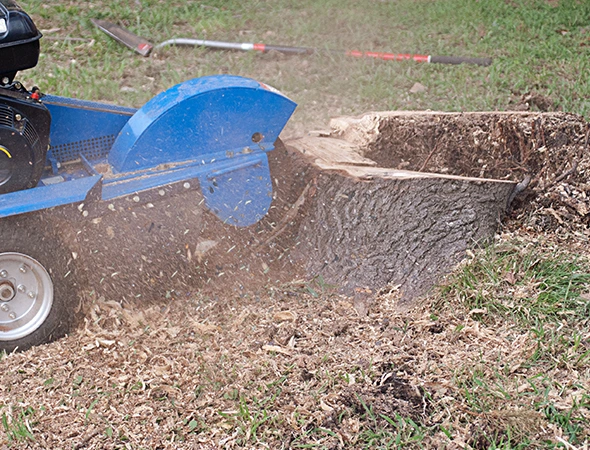
Stump grinding uses a machine with a spinning cutting wheel to chew the stump down into wood chips, going below ground level rather than just cutting it flush with the dirt. This is different from stump removal, which pulls the entire stump and root ball out of the ground with heavy equipment. Grinding is faster, costs less, and causes less damage to the surrounding yard, since there’s no digging involved.
The leftover wood chips can be hauled away or left in place as mulch, whichever you prefer. Roots below the grind line stay in the soil and break down naturally over time, which is normal and doesn’t cause problems for most lawns, gardens, or new plantings put in the same spot afterward.
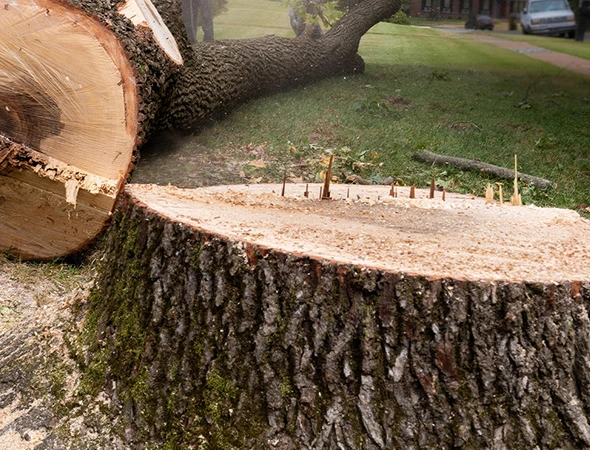
How deep does grinding go?
Depth is a choice, not a fixed setting, and it is worth deciding before we arrive.
Four to six inches below grade is enough if you want to mow over the spot. That clears the crown, gets the wood below blade height, and leaves you able to top with soil and seed.
Eight to twelve inches is what you want if something is going back in that spot — a new tree, a bed, a fence post, a patio. Deeper grinding takes longer and costs more, so there is no sense paying for it if the plan is grass.
What grinding does not remove. Grinding takes out the stump and the root crown immediately around it. The lateral roots running out under your yard stay where they are and rot down over several years. That is normal and it causes no problem for lawns, beds, or new planting nearby. Anyone offering to remove every root is either digging up your yard or not telling you the whole story.
Chips. A stump produces roughly two to three times its own volume in chips, because ground wood takes up more space than solid wood. Most people are surprised by the pile. We haul it away or leave it, whichever you prefer.
UTILITY MARKING BEFORE WE GRIND
A grinder going eight inches into the ground is excavation, and Texas requires underground utilities to be located before excavation begins.
Stumps sit near the things people bury. Irrigation lines, low-voltage lighting, gas service to a grill, the electric run to a shed. A stump next to a driveway or a property line is worth marking before anything spins.
If you know where your own private lines run — irrigation, landscape lighting, anything a previous owner put in — tell us at the quote. Private lines are not covered by the public locate service and you are the only person who knows they exist.
How to Tell You Need Stump Grinding
Pests Move In
A stump is dead wood at ground level, which is what termites and carpenter ants look for. A colony that establishes in a stump twenty feet from a house has a short walk.
Mowing Around It
A stump costs you time and mower blades every single cut. Hidden partly by grass, it costs you more than time.
You Want the Space Back
A stump occupies the one spot you wanted for a bed, a shed, a patio, or a new tree. Grinding is what makes that spot usable again.
A Tripping Hazard
A stump obscured by grass is a hazard rather than an eyesore, particularly on a route people walk without looking down.
It Was Left From a Removal
Removal and grinding are often quoted and scheduled separately, so a stump left behind is common. We grind stumps from our own removals and from work somebody else did years ago.
How We Grind a Stump
Site Inspection
We look at the stump, its size, what is around it, and what is likely under it. Access decides which machine comes, and a stump behind a locked gate is a different job from one beside a driveway.
Upfront Pricing
You get a fixed price based on the stump’s diameter, the depth you want, and how hard it is to reach. It does not change once we arrive.
Setup
We clear rocks and debris from around the stump first, because a grinding wheel that finds a rock throws it. Anything nearby that can be moved gets moved, and anything that cannot gets protected.
Grinding
The stump comes down to the agreed depth. Surface roots running out from the crown get ground where they break the surface.
Cleanup
Chips get hauled away, or raked back into the hole and left as mulch if you would rather keep them. If you are seeding the spot, fill it with topsoil rather than chips — grass struggles to establish in fresh wood chips.
STUMP GRINDING ACROSS THE BRAZOS VALLEY
Two things make stumps common here, and they are not the same in every town.
Cleared lots. College Station keeps growing, and new subdivisions are often built on lots cleared shortly beforehand, leaving several stumps behind before construction even starts. Multiple stumps on one site get quoted together and cost less each than a single stump visit.
Old, large trees. Bryan’s established neighborhoods have the oldest trees in the region, and Franklin and Navasota have large bottomland trees near the rivers. Post oak and pecan grow deep, wide root systems over decades, which makes their stumps a tougher and slower job than people expect from looking at the diameter.
Where a stump came from a tree that had to come down for safety, emergency tree removal usually handles the cutting first and grinding follows right after. Once the spot is clear, tree replacement is easiest to plan while the ground is already open.
Stump Grinding vs. Stump Removal
Grinding takes the stump out. Removal takes the stump and the root ball out.
Grinding is faster, costs less, and leaves the surrounding yard intact because nothing gets dug. It covers what most homeowners actually need: the stump gone and the ground usable.
Full removal digs out the entire root ball with heavy equipment. That matters if you are pouring a foundation, setting footings, or planting something with a deep root system in that exact spot. It also leaves a large hole and a disturbed yard, which is a real cost people do not think about until they see it.
If you are not sure which one fits, an arborist visit can look at the roots and the soil before you decide. For most properties in Bryan and College Station, grinding covers what is needed.
FAQs
Most stumps take between 30 minutes and two hours. Diameter matters less than you would think — an old post oak or pecan stump with a wide root crown takes longer than a bigger but younger stump. Nearly all jobs finish the same day, with cleanup straight after.
Yes. Tight spaces need a smaller machine and more care, and the grinder gets positioned to keep the wheel away from foundations, footings, and buried lines. That is part of why we look at the site in person before quoting rather than pricing from a photo.
Grass establishes over a ground stump within a few weeks to a couple of months, provided the hole is filled with topsoil rather than chips. Fresh wood chips tie up nitrogen as they break down, which is why seed struggles in them. We can top the spot with soil if you are planning to seed it.
Yes, and they work well as mulch on pathways or around established trees. Keep fresh chips away from vegetable beds and new planting, because breaking-down wood pulls nitrogen out of the soil around it for the first season.
Yes, across Bryan, College Station, Franklin, and Navasota. Commercial jobs often involve several stumps at once, usually after a lot has been cleared for construction, and multiple stumps on one site are priced together.
Contact Us
Have a stump taking up space? Call (979) 774-4800 or email brazosvalleystumpandtree@gmail.com for a free estimate.
Serving Bryan, College Station, Franklin, and Navasota.


